显示标签为“optical switch”的博文。显示所有博文

2023年10月19日星期四

What’s a Fiber Optic Switch?

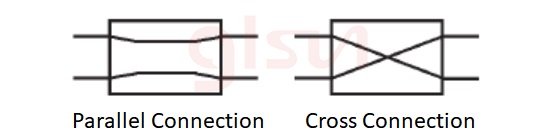
 Fiber Optic Switch is a device with one or more selected transmission windows that can perform mutual conversion or logical operation on optical signals in optical transmission lines or integrated optical circuits. The basic form of optical switch is 2x2, that is, every input port and output port have two optical fibers, which can complete two connection states, parallel connection and cross connection. The large space optical switch unit can be composed of the combination of a basic 2x2 and 1x2 fiber optic switch.
Optical switches play an important role in optical networks. In Wavelength Division Multiplexing (WDM) transmission systems, optical switches can be used for wavelength driving, regeneration and clock extraction. In Optical Time Division Multiplex (OTDM) system, optical switches can be used for demultiplexing; in all-optical switching systems, optical switches are key components of Optical Cross-connect (OXC), and are also important components for wavelength conversion. The number of input and output ports of the switch can be divided into 1×1, 1×2, 1×N, 2×2, 2×N, M×N, etc. They have different uses in different occasions. They can be widely used in protection switching system of optical network, light source control in optical fiber testing, real-time monitoring system of network performance, testing of optical devices, construction of switching core of OXC equipment, optical add/drop multiplexing, optical testing, optical Sensing systems, etc.

Main Types of Fiber Optic Switches

At present, the most widely used ones are still 1×2 and 2×2 mechanical optical switches. Traditional opto-mechanical optic switches can directly couple light to the output end through moving optical fibers, use prisms and reflectors to switch light paths, and send or reflect light directly to the output end.

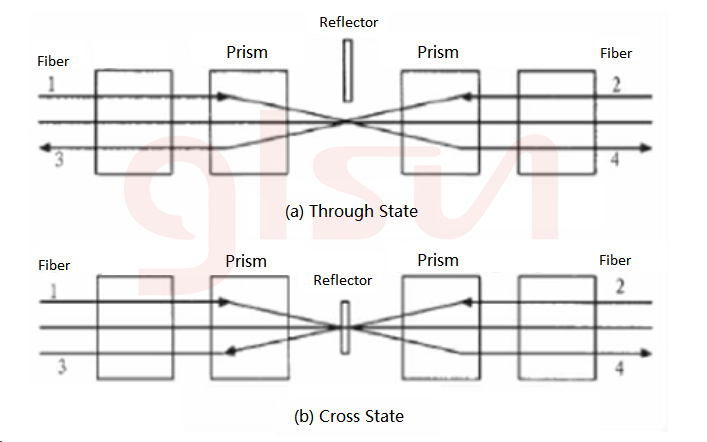
There are three main types of mechanical optical switches: one uses prism switching light path technology, the other uses mirror switching technology, and the third uses moving optical fiber to switch the light path. The optical fiber is connected to the lens (collimator) that plays a collimating role and is fixed. The optical path between the input and port output is changed by moving the prism. When the reflector does not enter the light path, the optical switch is in a straight-through state. The light entering from fiber 1 enters fiber 4, and the light entering from fiber 2 enters fiber 3. When the reflector is at the intersection of the two light rays, the optical switch is in the intersection state. , the light entering fiber 1 enters fiber 3, and the light entering fiber 2 enters fiber 4 to achieve optical path switching. The mobile optical fiber optical switch is an optical fiber with fixed ends. The device at the other end of the mobile device is connected to different ports of the fixed device to realize switching of optical paths. This type of optical switch has low return loss and is greatly affected by ambient temperature. There is no real switching product.
The advantages of mechanical optical switches are low insertion loss (<1dB), high isolation (>45dB), independent of wavelength and detour, and mature production technology. Faced with the total switching action time (ms), the size is relatively large, and it is not suitable for large-scale foreign optical switch matrices, and sometimes there are problems of rebound and poor repeatability. Mechanical optical switches have been widely used in recent years. However, as the scale of optical networks continues to expand, this type of switch is difficult to adapt to the future development needs of high-speed and large-capacity optical transmission networks.

Micro-electro-mechanical System (MEMS) Optical Switches

Microelectronic mechanical optical switches have developed rapidly in recent years. They are a new type of micro-electro-optical integrated switch produced by combining semiconductor micro-processing technology with micro-optical and micro-mechanical technologies. It is a new type of switch for large-capacity switching optical networks. The mainstream direction of switch development.

MEMS(Micro Electro-Mechanical System) optical switches are carved into a number of tiny lenses on a silicon crystal. Through the action of electrostatic force or electromagnetic force, the movable mirrors can be raised, lowered, rotated or moved, thereby changing the propagation direction of the input light to realize the function of optical path on/off. MEMS optical switches have obvious advantages over other optical switches. The switching time is measured in microseconds. MEMS fiber optic switch adopts IC manufacturing technology, is small in size and highly integrated. The working method has nothing with the format, protocol, wavelength, transmission direction, matrix direction, and modulation of the optical signal. It can process optical signals of any wavelength. Besides, it has the advantages of low insertion loss, low crosstalk, low polarization sensitivity, high extinction ratio, high switching speed, small size, and easy large-scale integration.

According to functions, MEMS optical switches can be divided into optical path bias type, moving fiber contact type and mirror reflection type. Mirror reflection type MEMS optical switches are easy to integrate and control, and can easily form an optical switch array. They are the focus of MEMS optical switch research. They can be divided into 2D MEMS optical switches and 3D MEMS optical switches. The concept of 1D MEMS fiber optic switches is also proposed. The so-called 2D means that the movable mirror and fiber are located on the same plane, and the mirror is either on or off at any specified moment. In this mode, the mirror array is connected to N input fibers and M output fibers. The number of mirrors required for an N×N matrix optical switch is N². Therefore this method is also called N² structure scheme.

2022年8月6日星期六

What Is Optical Communication?

 Optical communication is any type of communication in which light is used to carry the signal to the remote end, instead of electrical current. The transmitted information is firstly converted into an electrical signal in the transmitting end, and then the electrical signal is modulated onto the laser beam emitted by the light source, so that the light intensity changes with the frequency of electrical signal. Based on the principle of total internal reflection, the light signal is transmitted in optical fiber.

Due to the loss and dispersion of the optical fiber, the optical signal will be attenuated and distorted over a long distance transmission. It is necessary to amplify the attenuated signal at the optical repeater and repair the distorted waveform. At the receiving end, the detector converts the optical signal into an electrical signal after receiving it, the original information will be restored after demodulation. 


Advantages of Optical Transmission

  • Large Capacity and Long Transmission Distance
  • Small Size, Light Weight, Long Life and Low Cost
  • High Insulation and High Voltage Resistant
  • High Temperature and Anti-corrosion
  • Strong Adaptability and High Confidentiality


Optical communication consists of a series of optical communication devices. There are active devices and passive devices. Optical active devices are key devices in optical communication systems that convert electrical signals into optical signals or convert optical signals into electrical signals. Optical passive devices mainly include optical fiber patch cables, wavelength division multiplexers(WDM), optical splitters, optical switches, optical circulators and optical isolators, etc.


Optical fiber patch cord is a fiber optic cable with connectors at both ends to realize the connection of optical path. The cable with only one connector is called pigtail.


In fiber-optic communications, wavelength-division multiplexing (WDM) is a technology which multiplexes a number of optical carrier signals onto a single optical fiber by using different wavelengths. This technique enables bidirectional communications over a single strand of fiber, also called wavelength-division duplexing, as well as multiplication of capacity.


optical splitter is an optical device that splits a beam of light in two or more. There are two types of splitters: FBT couplers and PLC splitters.


Optical Switch is a device that switches or amplifies optical signals. It is mainly used to realize the physical switching of optical signal or other logical operation in optical path, and is often used as the key device of optical cross connection (OXC) technology to switch optical path.


An optical circulator is a three- or four-port optical device designed such that light entering any port exits from the next. This means that if light enters port 1 it is emitted from port 2, but if some of the emitted light is reflected back to the circulator, it does not come out of port 1 but instead exits from port 3.


An optical isolator is an optical component which allows the transmission of light in only one direction. The working principle is based on the non-reciprocity of Faraday rotation. Optical Isolator is typically used to prevent unwanted feedback into an optical oscillator, such as a laser cavity.


2022年7月27日星期三

Rack Optical Switch, Rackmount Fiber Optical Switches|GlsunMall

GLSUN Rackmounted optical switch is a kind of optical path control and switching device to choose working optical path switch manually with button and also control optical path switch or scan in frequency the optical switch which need to be monitored with RS 232 port and Ethernet port.


2022年7月21日星期四

GLSUN MEMS 1xN Optical Switch

GLSUN MEMS 1xN optical switch is based on micro-electro-mechanical system, which uses optical micro mirrors or optical micro-mirror arrays to change the propagation direction of light beam to achieve optical path switching. This 1xN MEMS Optical Switch is mainly used for DWDM networks, channel monitor and R&D in laboratory.


2022年7月15日星期五

All-Optical Switches: MEMS vs Mechanical Switches in Fiber Optical Network

In the optical fiber communication system, the Optical Switch (OS) is mainly used to realize the physical switching of optical signals or other logical operations in the optical path, and is mostly used in the optical cross-connect (OXC) technology as a key device for switching the optical path.


Types of Optical Switches

According to the number of input and output ports of the optical switch, it can be divided into 1x11x21xN 2x22xNMxN, etc. Thus optical switch has one or more transmission windows for different uses in different occasions.

Classified from the manufacturing process, optical switches can be divided into mechanical optical switches, thermo-optical switches, acousto-optical switches, electro-optical switches, magneto-optical switches, liquid crystal optical switches and MEMS optical switches, etc. Among them, mechanical optical switches and MEMS optical switches are two widely used optical switches.

Mechanical Optical Switches

The mechanical/optomechanical switch may be regarded as the oldest type of optical switches. The working principle of the mechanical optical switch is to redirect the optical signal by physically moving the optical fiber with the aid of a mechanical device. By moving the prism or the directional coupler, the light at the input end is directed to the required output port. There are three main types of mechanical optical switches: one is to use prism to switch the optical path technology, the other is to use mirror switching technology, and the third is to switch the optical path by moving optical fibers. Read more on All-Optical Switches: MEMS vs Mechanical Switches in Fiber Optical Network.


2022年5月31日星期二

What Does an Optical Switch Do in Fiber Optic Network

Optical Switch (OS) is a device used to close an optical circuit and selectably convert, logically switch the optical signal transmission in optical paths. An optical switch has one or more inputs ports and two or more output ports that is usually called 1xN or NxN optical switch.

Performance Parameters of Optical Switch

The quality of optical switches depends on fast switching speed, high isolation, low insertion loss, insensitivity to polarization and reliability. The applications in different fields have different requirements for its parameters. Main characteristic parameters of optical switches:

1. Insertion Loss

2. Return Loss: the ratio of the optical power returned from the input end to the input optical power.

3. Isolation: the ratio of the optical power of two isolated output ports.

4. Crosstalk: The ratio of the input optical power to the optical power output from the non-conducting port.

5. Extinction Ratio: The difference between the insertion loss of the two ports in the conducting and non-conducting states. ER=IL-IL0

6. Switching Time: The time required for the switch port to turn on or off from a certain initial state. Count from the moment when energy is applied or removed from the switch. Optical switches and optical amplification, optical signal storage, etc. are all optical device materials. The optical switch can be operated within picoseconds (10-12 seconds). At present, it is based on lithium niobate and gallium aluminum arsenic compound, formed from the electronics industry. Read more on Applications of Optical Switches


2022年5月10日星期二

1xN(N≤8) Rack Optical Switch, Swithing Optical Line Protection

GLSUN 1xN(N≤8) Rack-mounted Optical Switch is one of functional device to control and switch optical route. It can be manually selected from front panel or controlled via RS232 port, Ethernet port and auto-scanned on certain frequency.

In optical fiber transmission system, it is used for multi-channel fiber monitoring, multi light source/ detector selection, and optical fiber path protection etc. Besides, it is also used in optical fiber test system for optical fiber and its component test, outdoor cable test and multi-spot optical sensors monitoring system.

Features

·Low Insertion Loss and Fast Switching
·SerialNet, High Reliability, High Stability
·LCD Display
·RS232 Control and Ethernet Remote Management

Applications

·FITL
·Automatic Measurement
·Optical Network Remote Monitoring
·Cable Monitoring and Maintaining system


2022年4月12日星期二

MEMS Optical Switch: Advantages and Applications

 MEMS (Micro-Electro-Mechanical System) is a micro device or system integrating micro-machinery, micro-actuator, signal processing and control circuits, etc. Micro-mechanical structures are prepared by photo-lithography, ion beam etching, chemical etching, wafer bonding, etc., while electrodes are prepared on the mechanical structure for electronic control. Traditional switches with electricity as the core technology gradually lag behind the demand for high speed and large capacity optical communication, which gave rise to all-optical switches in the market. Among them, MEMS optical switches are widely used featuring compact size, low power consumption and good expansibility. 

Advantages of MEMS Optical Switches

Featuring main advantages of integration, low power consumption and low cost, MEMS optical switches can realize the overall remote control of all-optical network. MEMS optical switches combine the advantages of mechanical optical switches, such as low insertion loss, low crosstalk, low polarization sensitivity, high extinction ratio, and the advantages of waveguide optical switches, such as high switching speed, compact size and easy integration. The performance of MEMS optical switches can meet the technical requirements of DWDM all-optical network. MEMS devices have high single-batch yield, good economical efficiency, and good repeatability between devices, providing more possibilities for reducing system costs. Read more on Applications of MEMS Optical Switch


2021年12月13日星期一

Rack/Bypass Optical Switch, Link Selector,Optic Line Protection

GLSUN offers Rack-mounted Optical Switches, Smart Optical Bypass Switches, Optical Cross Protection, Multi-channel Optical Link Selector, DCM, EDFA for fiber optical cable and line protection.

Rack D1x32 Optical Switch


2016年5月16日星期一

The Key to Optical Network: Optical Switch Technology and Application


With the application of DWDM systems and the development of optical communication technology, optical networking has become the trend of network development. The realization of optical network technology depends on optical devices such as optical switches, erbium-doped fiber amplifiers (EDFA) and wavelength division multiplexer (WDM), and the improvement of optical technology. DWDM (Dense Wavelength Division Multiplexing) technology is the key factor promoting all optical network development, while optical network put great opportunity and challenge in front of equipment manufacturers and telecom operators.

Optical switch is the key in all-optical switching that can achieve routing switching, wavelength selection, OXC and self-healing protection in the all-optical layer. At present, optical switch main applications are:
OXC (optical cross connect). Composed of optical switches arrays, OXC can realize dynamic optical path management, optical network fault protection and flexible new business addition. OXC requires low insertion loss, low crosstalk, short switching time and non-blocking operation. Currently, MEMS technology is put into use.
Realizing network automatic protection switching by optical switch. When fiber breaks or transmission fails, optical switch, like 1x2 optical switch, can change the transmission path to achieve business protection.
Network monitoring by 1xN optical switch. At the optical fiber test points of distal end, 1xN optical switch connects several fibers with OTDR (optical time-domain reflectometer) so as to achieve monitoring of all fibers. Or use the network analyzer to achieve network on-line analysis.
Optical fiber communication device testing. When testing optical device, fiber cable and system product, optical switch is able to test several devices so that thus simplifies the test and increases the efficiency.
OADM. It is mainly used in circular MAN, to achieve a single wavelength and a plurality of wavelengths transmitted in the optical path up and down freely. Optical switch OADM can control any dynamic wavelength up and down by software to boost the flexibility of network configuration.

Conventional optical switching technology mainly uses two technologies: solid state waveguide and optomechanical. Because of high crosstalk and power loss, solid state waveguide is limited in a switches array, not suitable to expansion in a large-scale switch array. While optomechanical has low insert loss and crosstalk, it is also not suitable to large-scale switch array for its large equipment and ordinary expansibility. So far, a lot of new technologies have emerged, mainly including MEMS, Inkjet bubble optical switch, the liquid crystal optical switch, thermo-optic effect switch, acousto-optic switches, holographic switches and so on.

The following specifications are used to examine an optical switch: switching time, array size, insert loss, reliability, expansibility and so forth. The developments of different technologies vary with the different applications. The following is a summary on the major optical switches types and their applications.

MEMS (micro-electromechanical system) optical switches. MEMS is likely to be one of the mainstreams of the core optical switch devices, because it is less affected by the format, wavelength, protocols, modulation, polarization and optical signal transmission direction, but performs better than other types in loss and scalability, which is consistent with the trend of the future development of optical network. The principle is to switch the light route by static electricity or other controls driving the movable micro mirror rotate. In spite of complicated production process, MEMS used IC technology to achieve mass-produces and decrease the individual cost.


Magneto-optic switches. As technology developing fast and expanding its horizon to wider fields, magneto-optic switches emerge as the times require. Magneto-optic switches boast higher switching speed, better durability, higher reliability, low voltage drive, and fail-safe latching. The sophisticated micro-technique is a push to high-technology industry. The applications are promising in high-end science, such as aerospace, military, fire monitoring, oil field detection, medical science and so on. Thus, a manufacture’s strength is reflected in whether it masters the magneto-optic switch technology and is able to produce it.

PON. Optical switches are widely used in PON monitoring system to build up all optical networks nowadays. PON is necessary to fulfill FTTx. With zero natural environment influence like thunder and lightning, PON is the best choice to meet the need of present networking. PON is composed of OLT, ONU, ONT and ODN, while optical switches integrated in these devices play great role to transmit mass data and monitor the networking in case of fault and ensure signal transmission.


Multi-channel optical switches. Optical switches can be integrated into a module or an equipment as multi-channel optical switches featured wide wavelength range, low crosstalk, high stability, high reliability and modularized design. At present, there are 1x4, 1x8, 1x16, 4x4, 1xN, MxN and module-type multi-channel optical switches.

Micro optical switches. It is the fundamental and widely used optical component, including 1x1, 1x2, 2x2, 2x2, D1x2,D1x2B, D2x2, 2x2F and so on. Micro optical switch is famous for its high performance, low insertion loss and compact dimension. It is an ideal component for OADM, OXC, system monitoring and protection. With compact package, it can be easily integrated into a high density optical communication system.


With the popularization of optical networking concept, optical switch technology has become the key to the future all optical network. This article briefly introduces the optical switch technology and application to help understand what is in the optical networking.


2016年5月11日星期三

Bandwidth Upgrade Stimulate Next Generation PON Technology Evolution


    Recently, along with the growing needs of life, a variety of network-based applications are emerging. 3D TV, high-definition TV, 4K TV and even 8K television, virtual reality, and high-quality video services bring unparalleled audio-visual experience, and are becoming more common. Additionally, mobile devices like smartphones and tablet computers enable a large increase in network access devices and connections. In order to cope with such strong demand, PON technology providing high-bandwidth is widely used.

10G PON: the Mainstream Applied Technology of FTTx

      1G PON technology including EPON and GPON provides about 20-50 Mbps bandwidth for the end users. However, such bandwidth cannot fully meet the large bandwidth demand of 4K TV. Thus, ITU-T put forward XG-PON1 technology which can provide 10 Gbps (four times as GPON’s) downstream bandwidth and 2.5 Gbps (two times as GPON’s) upstream bandwidth. IEEE also proposed 10G EPON standard lifting the downstream speed up to 10Gbps. It is significant to have the equivalent bandwidth in some application fields. Nowadays, the research for 10G PON technology has been completed, a series of industry standard has been set, and the specification has been released, like the 802.3av of 10 G EPON, and ITU-T G.987 and G.988 of 10G GPON. In support of these standards, 10G PON devices can be mass-produced.

     Thanks to the mature industry chain and excellent performance, 10G PON has become the mainstream technology. It is suitable for a variety of deployment scenarios, such as buildings, residential renovation, high-end home, small and medium company broadband access, and mobile backhaul. The very key is that 10G PON and 1G PON can perfectly co-exist by reusing ODN and appropriate deployment of wavelength, which means that carriers can more easily achieve the smooth evolution of network construction. For traditional carriers, it helps improve user experience, enhance user stickiness, and maintain competitive position; for new carriers, it offers an idea to boost competitiveness in differentiation and competition.

10G PON Application: Building and Residential Renovation

      This application makes full use of the bandwidth of 10G PON technology, and provides large user covering and access bandwidth up to 100M even to 1G. Moreover, by fully using the existing resources UTP cable, twisted pair, network, etc., it can achieve rapid deployment and service fulfillment, thereby reducing capital expenditures. 

10G PON Application: High-end Home, Enterprise and Campus Broadband Access

      10G PON is the best selection for the brand new allocation serving the high-end users. It provides 1G to 10G bandwidth access sufficient to support high-end home and business users that demand high-bandwidth applications such as high-speed internet access, cloud storage, ultra-high-definition video, and 3D / VR online gaming service. In such situation, 10G PON access helps to improve user satisfaction thus consolidate, and even increase revenue.

10G PON Application: Mobile Backhaul

        In the era of mobile Internet, mobile communication occupies an important share of the communications market. Therefore, it is very necessary to offer carriers with a flexible-access and low-cost mobile traffic bearer solutions that can support massive business. And the 10G PON that can be deployed in various indoor and outdoor scenes is exactly in line with this demand. Not only 10G PON and small cell are perfect match, but also the existing FTTX resources give great convenience to LTE small cell that requires high-density deployments.

NG-PON2: 10G PON in The Future

       The existing mainstream 10G PON can ensure most communication services, yet the demand for bandwidth will be increasing. Ultra high-definition video services including VR and 8K TV, and the new generation mobile communication technology including Pre5G and 5G requires a lot of communication bandwidth, and is likely to bring greater data traffic in the future. Early in 2009, FSAN began researching NG-PON2, the next generation PON networking technology. In 2012, FSAN chose TWDM-PON as the mainstream NG-PON2 technology while PtP WDM PON as supplement. And it is regarded as the milestone in the history of NG-PON2 technology development. By the end of 2015, FSAN has finalized G.989.1、G.989.1 Amd1, G.989.1 Amd2, and a number of technical recommendations. At the same time, IEEE is in full swing researching and developing NG-EPON technology as a next-generation evolution direction for 10G EPON technology.

      At present, NG-PON2 corresponding standard G.989 series is in the research stage. And numerous details involving technical indicators and management methods await further discussion and confirmation. What’s more, the immature chain also greatly limits the commercialization of NG-PON2. Manufacturer’s NG-PON2 product is still in the prototype stage. Some of the key components like standard package optical modules are still very lacking, resulting in much higher cost of NG-PON2 than XG-PON1. Therefore, it is expected that NG-PON2 will be put into scale applications possibly after 2020.


2016年5月4日星期三

Give MEMS A Fulcrum, and It Shall Move The World

What is MEMS?

MEMS is short for Micro-electro-mechanical Systems. It s a technology that are made using the techniques of microfabrication. So MEMS has very small size ranging 1μm~several mms.

Functional elements of MEMS are miniaturized structures: microstructure, microsensors, microactuators and microelectronics, among which the most notable components are the microsensors and microactuators. Despite small size, MEMS exerts great function in various fields including  astronomy, networking, communications and so on.

How MEMS works?

The principle is simple. Microsensors and microactuators convert energy from one form to another, like a measured mechanical signal into an electrical signal. Electromagnetic induction works through mechanical arm + electrode (made of electromagnetic coil) to drive it work. When electromagnet induction lines mechanical arm with transmission line, it's on. To the contrary, when mechanical arm is disconnected with transmission, it is off.

Features of MEMS

 MEMS is distinguished with Smart and Multidisciplinary.


MEMS is Extremely Small and available for Batch Production


MEMS boasts Multifunction and High Level of Integration

MEMS Applications

As a breakthrough technology, there are numerous possible applications for MEMS. MEMS is enabling new discoveries in science and engineering. It has been widely used in motor, medicine and environment and made great contribution to daily life. 

Besides, MEMS owns huge potentials in communication, optical network and process automation. As we are at the threshold of an era of 5G, MEMS will participates in connecting the future which requires higher, faster and better networking with  the world of mass data and information. 

At present, MEMS is cutting a figure in home security, chemistry, pharmacy and food processing. 

GLSUN MEMS Productions

As the biggest Optical Switch & component manufacturers in Asia, Glsun provides high quality MEMS series productions including MEMS Optical Switches and MEMS VOA.

With miniature size, high reliability high durability and low insertion loss, Glsun MEMS optical switches apply to optical channel monitoring, configurable OADM DWDM networks, test & measurement and instrumentation.

Glsun MEMS VOA features low insertion loss, fast response, high stability and miniature size. VOA has many applications, such as optical power controller & equalizer, EDFA gain control, and WDM channel equalizer


As is shown above, due to the tiny size, MEMS is able to apply in many significant industries to build a more convenient world. Now we are standing in a fast changing world full of information. Higher efficient, world moves faster. And MEMS contributes to high-speed data transmitting. Give MEMS a fulcrum, and it shall move the world!


More information about MEMS and optical components is on www.glsun.com