显示标签为“mems optical switch”的博文。显示所有博文

2024年6月13日星期四

What's the difference between 2D MEMS and 3D MEMS Switches?

MEMS (Microelectromechanical Systems) optical switches are devices that use microelectromechanical systems technology to switch light signals between different optical paths. They are typically used in telecommunications and data center applications.

There are two main types of MEMS optical switches: 2D MEMS optical switches and 3D MEMS optical switches.

2D MEMS optical switches have a simple design and are relatively easy to manufacture. They consist of a glass substrate with a thin layer of silicon on top. The silicon layer is patterned with a series of mirrors, which are actuated by electrostatic forces. When an electrical signal is applied to the mirrors, they rotate and reflect the light to the desired output port.


2D MEMS optical switches are available in a variety of configurations, including 1x2, 1x4, and 1x8. They can also be used to switch between multiple wavelengths of light.

3D MEMS optical switches are more complex than 2D MEMS optical switches, but they offer a number of advantages. 3D MEMS optical switches have a smaller footprint and are less power-hungry than 2D MEMS optical switches. They also offer lower insertion loss and crosstalk.


3D MEMS optical switches are available in a variety of configurations, including 1x2, 1x4, and 1x8. They can also be used to switch between multiple wavelengths of light.

2D MEMS Switches vs 3D MEMS Switches


MEMS optical switches are used in a variety of applications, including:

* Telecommunications
* Data centers
* Medical imaging
* Industrial automation
* Aerospace

GLSUN, an optical switch raw manufacturer with more than 20 years of design and production experience.

We provide customized solutions for a full range of optical switches, including relays, stepper motors, MEMS, magnets and nanosecond types. With the features of low loss, fast, cost-effective and reliable. Widely used in fiber optic communication, fiber optic sensing, quantum computing, network security and monitoring, etc.


2024年4月21日星期日

MXN Matrix Optical Switch in Data Centers

In today's rapidly evolving digital landscape, data centers serve as the backbone of modern infrastructure. They house countless servers that process and store vast amounts of data, supporting critical business applications and services. To meet the demands of this ever-expanding data ecosystem, data centers require high-performance networking solutions that can optimize bandwidth utilization, minimize latency, and ensure reliability. MXN Matrix Optical Switches play a vital role in fulfilling these requirements.

An MXN matrix optical switch is a multi-port optical fiber switch that provides full connectivity between any input and output port. It employs a non-blocking architecture, allowing simultaneous and independent data transmission between all connected devices. MXN matrix optical switches are designed for high-speed data communication applications, supporting data rates up to 100Gb/s and beyond.


What are the advantages of MXN matrix optical switches in data centers?

Increased Bandwidth Utilization:

The non-blocking architecture of MXN Matrix Optical Switches enables maximum bandwidth utilization by eliminating contention between input and output ports. This allows data to flow freely between any connected device, ensuring optimal performance for bandwidth-intensive applications.

Reduced Latency:

MXN matrix optical switches offer extremely low latency, minimizing the time it takes for data to traverse the network. This is crucial for real-time applications, such as high-frequency trading and online gaming, where even the smallest delay can significantly impact performance.

Enhanced Reliability:

Reliability is paramount in data centers. MXN matrix optical Switches are designed with redundancy and fault tolerance mechanisms to minimize downtime and ensure continuous data transmission. Redundant components and automated failover capabilities guarantee high availability and uninterrupted network operations.

Simplified Management:

MXN Matrix Optical Switches are equipped with advanced management interfaces that enable remote monitoring and control. This simplifies network administration tasks, reduces operational expenses, and allows for quick troubleshooting and maintenance.


MXN Matrix Optical Switches find widespread applications in data centers, including:

Data Center Interconnection: Establishing high-bandwidth, low-latency connections between multiple data center sites for data replication, disaster recovery, and workload balancing.

Cloud Computing Architectures: Providing flexible and scalable connectivity between virtual machines and containers, facilitating dynamic resource allocation and load balancing in cloud environments.

High-Speed Networking: Supporting high-speed data transmission for bandwidth-intensive applications, such as big data analytics, video streaming, and artificial intelligence.

Content Distribution Networks (CDNs): Distributing content across edge nodes and core data centers, reducing latency and improving content delivery quality for end-users.


2023年11月16日星期四

MEMS Optical Switches - A Key Technology for the Future of Optical Communications

Introduction

MEMS optical switches are a type of optical switch that uses microelectromechanical systems (MEMS) to control the flow of light. MEMS are miniature mechanical devices that can be fabricated on a semiconductor substrate using a variety of techniques, including photolithography, etching, and deposition.

MEMS optical switches offer a number of advantages over other types of optical switches, including:

Small size and weight: MEMS optical switches are typically much smaller and lighter than other types of optical switches, making them ideal for applications where space and weight are limited.

Low power consumption: MEMS optical switches typically consume much less power than other types of optical switches, making them more energy efficient.

High reliability: MEMS optical switches are typically very reliable, with failure rates of less than 1%.

Types of MEMS Optical Switches

There are two main types of MEMS optical switches:

  • Rotary MEMS optical switches: Rotary MEMS optical switches use a rotating mirror to control the flow of light.
  • Tilting MEMS optical switches: Tilting MEMS optical switches use a tilting mirror to control the flow of light.

Applications of MEMS Optical Switches

MEMS optical switches are used in a wide variety of applications, including:

Telecommunications:

MEMS optical switches are used in telecommunications networks to route optical signals between different nodes.

Data centers:

MEMS optical switches are used in data centers to connect servers and other network devices.

Medical imaging:

MEMS optical switches are used in medical imaging devices to control the flow of light.

Industrial automation:

MEMS optical switches are used in industrial automation systems to control the flow of light.

Future Trends

The market for MEMS optical switches is expected to grow significantly in the coming years. This is due to the increasing demand for small, lightweight, and reliable optical switches in a variety of applications.

Conclusion

MEMS optical switches are a versatile and reliable technology that is finding increasing use in a wide range of applications. As the demand for small, lightweight, and reliable optical switches continues to grow, MEMS optical switches are well positioned to continue to play a leading role in this market.

2023年10月19日星期四

What’s a Fiber Optic Switch?

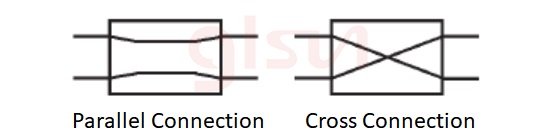
 Fiber Optic Switch is a device with one or more selected transmission windows that can perform mutual conversion or logical operation on optical signals in optical transmission lines or integrated optical circuits. The basic form of optical switch is 2x2, that is, every input port and output port have two optical fibers, which can complete two connection states, parallel connection and cross connection. The large space optical switch unit can be composed of the combination of a basic 2x2 and 1x2 fiber optic switch.
Optical switches play an important role in optical networks. In Wavelength Division Multiplexing (WDM) transmission systems, optical switches can be used for wavelength driving, regeneration and clock extraction. In Optical Time Division Multiplex (OTDM) system, optical switches can be used for demultiplexing; in all-optical switching systems, optical switches are key components of Optical Cross-connect (OXC), and are also important components for wavelength conversion. The number of input and output ports of the switch can be divided into 1×1, 1×2, 1×N, 2×2, 2×N, M×N, etc. They have different uses in different occasions. They can be widely used in protection switching system of optical network, light source control in optical fiber testing, real-time monitoring system of network performance, testing of optical devices, construction of switching core of OXC equipment, optical add/drop multiplexing, optical testing, optical Sensing systems, etc.

Main Types of Fiber Optic Switches

At present, the most widely used ones are still 1×2 and 2×2 mechanical optical switches. Traditional opto-mechanical optic switches can directly couple light to the output end through moving optical fibers, use prisms and reflectors to switch light paths, and send or reflect light directly to the output end.

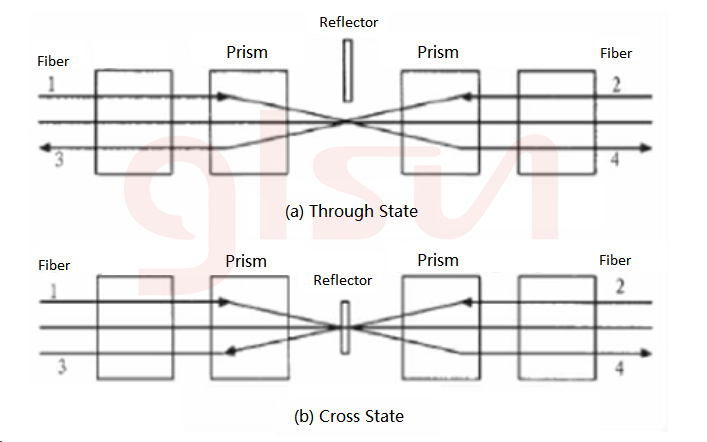
There are three main types of mechanical optical switches: one uses prism switching light path technology, the other uses mirror switching technology, and the third uses moving optical fiber to switch the light path. The optical fiber is connected to the lens (collimator) that plays a collimating role and is fixed. The optical path between the input and port output is changed by moving the prism. When the reflector does not enter the light path, the optical switch is in a straight-through state. The light entering from fiber 1 enters fiber 4, and the light entering from fiber 2 enters fiber 3. When the reflector is at the intersection of the two light rays, the optical switch is in the intersection state. , the light entering fiber 1 enters fiber 3, and the light entering fiber 2 enters fiber 4 to achieve optical path switching. The mobile optical fiber optical switch is an optical fiber with fixed ends. The device at the other end of the mobile device is connected to different ports of the fixed device to realize switching of optical paths. This type of optical switch has low return loss and is greatly affected by ambient temperature. There is no real switching product.
The advantages of mechanical optical switches are low insertion loss (<1dB), high isolation (>45dB), independent of wavelength and detour, and mature production technology. Faced with the total switching action time (ms), the size is relatively large, and it is not suitable for large-scale foreign optical switch matrices, and sometimes there are problems of rebound and poor repeatability. Mechanical optical switches have been widely used in recent years. However, as the scale of optical networks continues to expand, this type of switch is difficult to adapt to the future development needs of high-speed and large-capacity optical transmission networks.

Micro-electro-mechanical System (MEMS) Optical Switches

Microelectronic mechanical optical switches have developed rapidly in recent years. They are a new type of micro-electro-optical integrated switch produced by combining semiconductor micro-processing technology with micro-optical and micro-mechanical technologies. It is a new type of switch for large-capacity switching optical networks. The mainstream direction of switch development.

MEMS(Micro Electro-Mechanical System) optical switches are carved into a number of tiny lenses on a silicon crystal. Through the action of electrostatic force or electromagnetic force, the movable mirrors can be raised, lowered, rotated or moved, thereby changing the propagation direction of the input light to realize the function of optical path on/off. MEMS optical switches have obvious advantages over other optical switches. The switching time is measured in microseconds. MEMS fiber optic switch adopts IC manufacturing technology, is small in size and highly integrated. The working method has nothing with the format, protocol, wavelength, transmission direction, matrix direction, and modulation of the optical signal. It can process optical signals of any wavelength. Besides, it has the advantages of low insertion loss, low crosstalk, low polarization sensitivity, high extinction ratio, high switching speed, small size, and easy large-scale integration.

According to functions, MEMS optical switches can be divided into optical path bias type, moving fiber contact type and mirror reflection type. Mirror reflection type MEMS optical switches are easy to integrate and control, and can easily form an optical switch array. They are the focus of MEMS optical switch research. They can be divided into 2D MEMS optical switches and 3D MEMS optical switches. The concept of 1D MEMS fiber optic switches is also proposed. The so-called 2D means that the movable mirror and fiber are located on the same plane, and the mirror is either on or off at any specified moment. In this mode, the mirror array is connected to N input fibers and M output fibers. The number of mirrors required for an N×N matrix optical switch is N². Therefore this method is also called N² structure scheme.

2023年6月19日星期一

The Applications of MEMS Optical Switches

 MEMS optical switch is based on micro-electro-mechanical system, using optical micromirror or optical micromirror array to change the propagation direction of light beam to realize the switching of optical path. What scenarios can MEMS optical switches be applied to?


MCS(Multicast Optical Switch)
The multicast optical switch (MCS) based on PLC technology and MEMS technology is a key component of the next-generation reconfigurable optical add-drop multiplexing system (ROADM); Every functional unit consists of 1xM Splitters and 1xN MEMS optical switches; provide connections from N add (or drop) ports to M directions.


iODF (Intelligent Optical Distribution Frame)
Through the cascade integration of optical switches, it can be used in iODF to replace the traditional distribution frame in the industry private network.


OXC (Optical Cross Connect)
Through the cascade integration of optical switches, it can be used in small-scale OXCs to meet the needs of industry private networks and key lines in data centers.


Optical Performance Monitoring
Integrated with TOF or OPM, combined with monitoring software, through Time Division Multiplexing TDM, to monitor the signal performance of DWDM channel in the multi-core optical fiber in the optical cable, widely used in optical transmission network optical cable monitoring, ROADM network, DCI, etc.


Optical Cable Monitoring
Integrated with OTDR, combined with monitoring software, through time-division multiplexing OTDR, to monitor the quality status of multi-core optical fibers in optical cables, widely used in the optical cable monitoring of PON network, optical transmission network, enterprise private network, etc.


Fiber Optic Sensing
The main products are 1x4 and 1x8 for fiber optic sensing.


Test Instrumentation and Factory Automation
The test instrument and factory automation markets are relatively small, but they have high added value and have high requirements on the optical performance of optical switches, such as insertion loss, return loss, and repeatability.


DWDM System
Channel power equalization, link node power attenuation, optical receiver protection, and fast control of optical line on/off.

2022年5月6日星期五

1x8 MEMS Optical Switch, Single Mode Fiber Switches|GLsunMall

GLsun 1x8 MEMS Fiber Optical Switch is based on MEMS technology and features High Stability, High Reliability and Epoxy-free on Optical Path.It is mainly used for DWDM networks,Channel Monitor and R&D in Laboratory with Storage Temperature:-40~+85℃.


2021年12月23日星期四

Optical Switches: Mechanical, Magneto, MEMS Optical Switch|GLsun

 GLsun manufatures all types of Mechanical Optical Switches, MEMS 1xN, NXM Optical Switches, High Speed Magneto Optical Switches with low loss, high speed, small size, reliable quality.

 GLsun 2x2B Optical Switch

GLsun 2x2B Optical Switch

GLsun 2x2B Optical Switch

GLsun 2x2B Optical Switch


2021年12月16日星期四

MEMS Optical Switch 1xN, MxN Matrix Optical Switches|GLSUN

 GLsun single-mode MEMS 1xN (1x2-1x64) and (2x2-2X16, 3X24, 4x4) MxN 3D Matrix Optical Switches based on Microelectromechanical Systems allow the simultaneous connection of multiple input to output fibers for DWDM network, ROADM, channel monitor and more applications.

GLsun MEMS Optical Switch